

Thirteen years ago I first dived into the public discussion of community water fluoridation in Lincoln, where I live, when a citizen proposed that our town cease fluoridating the water because of risks of certain rare cancers alleged to be from fluoridation. I found those assertions to be untrue as well as outdated.
I wrote an op-ed piece for the then-existent Lincoln Journal laying out the science more accurately and participated actively in the subsequent town meeting that resoundingly rejected any change to our water. That saga is well described in my post from that time, The Forces of Darkness Are Still Strong.
My unexpected activism got me appointed and then elected to the town board of health, where I continue to serve.
Fluoridation Risk Concerns Recur
In the last few years some epidemiological studies raised concerns about apparent IQ reduction from fluoride exposure during childhood development. A meta-analysis from JAMA Pediatrics by K. Taylor, et al. in 2025 is a recent addition in support of these concerns.
Most of the studies aggregated in the JAMA meta-analysis were heavily based on work done in communities in China and other developing countries, where the background fluoride concentrations are quite high, ranging from over 1.5 mg/L to 4 mg/L and much higher, unlike community water fluoridation (CWF) in the United States which has been fixed at 0.7 mg/L for decades. In addition, many of these studies were judged poorly executed or documented.
Other Studies Show No Adverse Effect
A 2022 study of children’s early cognitive development related to actual community water fluoridation for prevention of caries, with exposure at fluoride levels below 1.1 mg/L (Early Childhood Exposures to Fluorides and Cognitive Neurodevelopment: A Population-Based Longitudinal Study) was done in Australia. It found no association of community water fluoridation and lowered IQ: “Exposure to fluoridated water during the first 5 y of life was not associated with altered measures of child emotional and behavioral development and executive functioning.”
And another study from the subsequent year, Association between low fluoride exposure and children’s intelligence: a meta-analysis relevant to community water fluoridation – ScienceDirect, also showed no effect on childhood cognitive development in communities with water fluoride 0.9 v 0.3 mg/L (which includes the target level of 0.7 for normal CWF), but did confirm reduction in child IQ scores at fluoride levels of 3.7 compared to 0.7 mg/L.
Chemical Levels Matter in Toxicity
Community water fluoridation at the level of 0.7 mg/L of fluoride has been in wide use for over 80 years in this country. It has essentially stopped tooth decay among children where CWF is implemented. That means fewer trips to the dentist, carious teeth and lost teeth, subsequent bad gum disease, poor nutrition and higher risk of cardiac disease related to chronic gum inflammation.
Higher levels of fluoride, such as 4.0-10.0 mg/L (7-10 times higher than CWF rate), have adverse effects including dental fluorosis and brittle bones and may well have adverse neurocognitive effects. But that simply doesn’t apply to the CWF level of <1.0 mg/L.
Many substances in common use at certain doses are toxic at much higher doses. For example, iron is essential to human body functioning, with a role in blood cells and muscle cells. Sometimes iron supplementation is needed, especially in pregnant women. But persistent, high intake of iron (by pills or cooking in iron pots or genetic absorption disorders) can produce iron overload and a condition called hemochromatosis, which can profoundly damage the liver and heart.
Even water, essential to life and clearly safe in routine use, can be acutely harmful. Rapid consumption of very large amounts of water (say a gallon or two in a short period) can produce dilution of the blood and secondary brain swelling, which can be harmful and even fatal.
We’d Really Need Life-Long Cognitive Data
Many of the arguments in the conflicting studies I cite above hinge on the method and quality of the meta-analyses they do. That ultimately consists of taking study groups of children, trying to measure urinary fluoride or blood fluoride samples, as well as gathering the water fluoride levels for the various communities where they live to calculate fluoride exposure, as well as the demographics of each child and family, good IQ tests, perhaps several over a few years, and analyzing the data comparing children who were exposed to fluoride at some level v. not being exposed.
In such a slice of life it is truly hard to get clean data. And when you include very high fluoride exposure (such as background water levels of 7-10 mg/L) you are not necessarily producing data that is at all relevant to CWF with its dramatically lower fluoride levels of 0.7 mg/L. And we have no adult data on cognition.
What we’d really like to know, I think, is if you looked at children who were exposed to standard CWF from birth or during their early development, how did they fare intellectually over their early and teenage years, and then on into later life, through middle age and older, compared to people not so exposed to fluoride? There is no need to do highly variable urine fluoride measurements. Just good socioeconomic data to be able to correct for inherited IQ and proper records of IQ tests and fluoride exposure over decades.
That sounds like an impossible task. A large cohort study, at least 10,000 people followed for decades, with multiple IQ tests throughout life. That would certainly answer the question as to whether early exposure to fluoride affects IQ during adolescence and adulthood. But who would fund such a study? And if it started now, we’d all be long dead before the results are in. But no!
Deus Ex Machina in April
Such a large cohort mult-decade study of fluoride and cognition was just released 3 weeks ago, on April 13, in the Proceedings of the National Academy of Sciences (PNAS). Titled Municipal water fluoridation, adolescent IQ, and cognition across the life course: Evidence from theWisconsin Longitudinal Study (J. Warren, et al.), the study reported no cognitive harm associated with community water fluoridation over more than six decades of follow‑up.
The work is based on the Wisconsin Longitudinal Study (WLS), which has followed members of the Wisconsin high‑school graduating class of 1957 from adolescence into old age, with cognitive outcomes observed over approximately 65 years. The cohort for this analysis included 10,300 members. They received age-appropriate IQ tests in high school at age 15-16 and subsequently at ages 53, 64, 72 and 80.
Data on family income, parental education, father’s occupation, sibship size, community size, and school-level socioeconomic composition were collected routinely, so group IQ data could be adjusted by relevant socioeconomic factors.
Then, here’s what’s amazing to me. Beyond retrieving all the individual cognitive test results over decades from the WLS, the study authors went back to old census records and primary historical state records to determine where each study subject lived each year during their lives, especially in the first two decades, and checked whether the community water was fluoridated naturally or by CWF, and at what concentration level for each year. Wow.
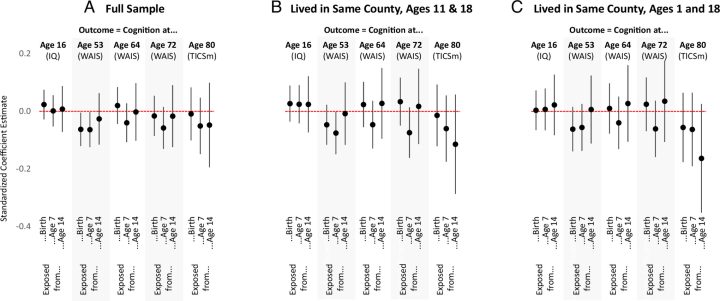
This data enabled them to group their cohort into 4 fluoride exposure groups for comparison: Never exposed to fluoride, or exposed to fluoride from birth, from about age 7-8, from about age 14, the ages where there has been the most concern about impaired neurocognitive development.
| Fluoride exposure category | Number of individuals |
|---|---|
| No fluoride exposure | 3,614 |
| Exposed from birth | 2,595 |
| Exposed beginning ~age 8 | 2,087 |
| Exposed beginning ~age 14 | 2,021 |
| Total | 10,317 |
No IQ Differences Found
The authors compared the IQ scores for each of the exposure groups (from birth, from age 8, from age 14) to the IQ scores for the subjects not exposed to fluoride, at the five different test years (16, 53, 64, 72 and 80). And they did this for the entire subject group, then for those with shorter or longer duration in their county. Of those 45 adjusted exposure-outcome comparisons (shown in Fig 1 included), only 2 coefficients differed from zero, the number expected by chance.
New Study Supports Long-Term Fluoride Safety
The result is impressive. Their study group covered about 650,000 person-years of cognitive observation after childhood fluoride exposure. No cognitive change occurred in any of the 5 times over about 65 years in which IQ was tested. If there was any meaningful neurocognitive impairment, it would have shown up in earlier years in school, or in midlife, or in later life. Nothing has shown up.
The authors wrote, “We find no evidence that CWF (community water fluoridation) is associated with lower adolescent IQ or cognition later in life.”
In the past year several states (Utah and Florida) banned CWF based on flawed studies such as the K. Taylor et al. JAMA study above. Their populations are likely to lose fluoride’s substantial dental and general health benefits because policy decisions relied on evidence drawn largely from non-representative or high-exposure studies.
I am hopeful that this PNAS study will hold its proper weight in public discussion about the cognitive safety of CWF so that everyone can continue to receive its benefits.