
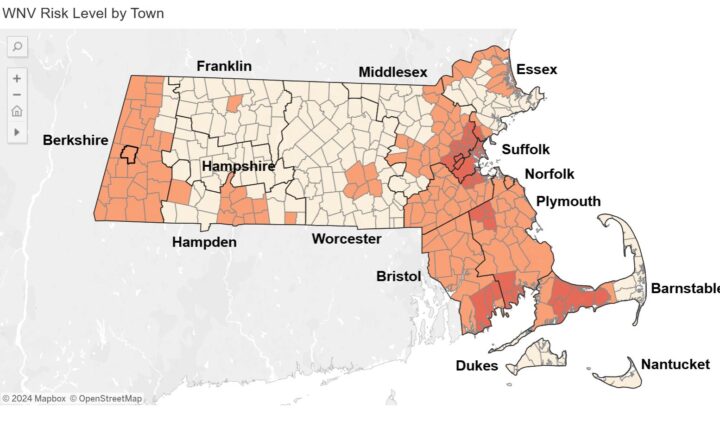
Since the beginning of September, residents of the western suburbs of Boston and southeastern Mass have been subject to significantly heightened risk of mosquito-borne infection with West Nile Virus (WNV) and Eastern Equine Encephalitis (EEE).
Tracking WNV and EEE
The Massachusetts Department of Public Health (DPH) tracks the presence of infected mosquitos as well as human cases to make its risk estimates, which are published and updated daily at its arbovirus dashboard, Massachusetts arbovirus update | Mass.gov.
For example, as of today (9/18/24) the EEE risk is High in Concord and Acton, and Moderate in most other adjacent towns. The WNV risk is Moderate in Waltham and Weston and many adjacent suburbs but becomes High as you head toward and into Boston.
Staying Safe
EEE and WNV are serious viral diseases, which may result in severe neurological damage or death, and for which there are no vaccines and no specific treatments. Avoidance of mosquito bites is the major preventive tool, taking especial care between dusk and dawn when mosquitos are most active. Consider indoor rather than outdoor activities after dusk. Wear long sleeves and use effective mosquito repellants with products containing DEET, permethrin or picaridin.
Check the arbovirus dashboard for current risk levels. There also is more detailed guidance on the website for the Lincoln Board of Health, where I am a member.
Frosts Kill Mosquitos
Mosquitos largely die off with the first real frost, which should occur by late September or early October. Until then we are likely to continue with varying but elevated risk of both infections. Don’t be fearful or paranoid during this beautiful late summer/early fall time. Enjoy yourself and friends and family. But do be prudent.
2 comments
adostrom
I’m sure that EEE is a nasty disease, but let’s put the risk into perspective. So far in 2024, across the entire Commonwealth, there have been 4 human and 2 animal confirmed cases of EEE. Our local Board of Health is all excited about it, basically telling us not to go outside at night. The night when it’s getting colder and the mosquitos are inactive or dying… The risk of EEE is infinitesimally small for the amount of resources being spent on it. I’m sure that an equal amount of urgency about drinking and driving or cancer screening, or any of many other health initiatives would have a much bigger payback.
DrKanner
Andy,
Thank you for thoughtful comments.
I agree that the risk of EEE and WNV needs to be kept in perspective. This year so far there have been 4 human cases of EEE and 11 cases of WNV in the Commonwealth, most in the general area where most of our readers live. This sounds like very small numbers. However, by contrast, in 2023 in Massachusetts (DPH data) there were no cases of EEE and only 3 cases of WNV. Similarly, in 2022 there were no cases of EEE and 5 cases of WNV.
So this year is different. The level of risk for EEE and WNV by mosquito capture and number of cases is now as high as it has ever been in my decade or more on the Lincoln Board of Health. It is our responsibility to inform our townspeople of this fact. Clearly the concern is that these viral infections can be quite severe and even deadly and have no specific therapy. The only preventive is avoidance of mosquito bites.
I fully understand and support that each person has the ability and right to respond to any given risk however they choose. Risk tolerance is an individual’s choice. I am certainly not recommending everyone hibernate indoors, nor is the BOH in our little town of Lincoln.
My suggestion for the right level of response is for my readers to be aware of the added risk and to be prudent, specifically to consider indoor alternatives for evening activities and to wear long-sleeved shirts and pants plus DEET or equivalent mosquito repellents if you prefer to do evening outdoor activities. I personally think that the clothing and DEET suggestions are a low-cost action with high degree of benefit to protect against an unlikely and potentially deadly infection for which there is no specific treatment. You may differ in your risk tolerance, which I respect.